



Epigenetic Reader Domain
Epigenetic regulators of gene expression and chromatin state include so-called writers, erasers, and readers of chromatin modifications.Well-characterized examples of reader domains include bromodomains typically binding acetyllysine and chromatin organization modifier (chromo), malignant brain tumor (MBT), plant homeodomain (PHD), and Tudor domains generally associating with methyllysine. Research on epigenetic readers has been tremendously influenced by the discovery of selective inhibitors targeting the bromodomain and extraterminal motif (BET) family of acetyl-lysine readers. The human genome encodes 46 proteins containing 61 bromodomains clustered into eight families. Distinct experimental approaches are used to identify the first BET inhibitors, GSK 525762A and (+)-JQ-1.
The Polycomb group (PcG) protein, enhancer of zeste homologue 2 (EZH2), has an essential role in promoting histone H3 lysine 27 trimethylation (H3K27me3) and epigenetic gene silencing. This function of EZH2 is important for cell proliferation and inhibition of cell differentiation, and is implicated in cancer progression. Cyclin-dependent kinases regulate epigenetic gene silencing through phosphorylation of EZH2. In many types of cancers including lymphomas and leukemia, EZH2 is postulated to exert its oncogenic effects via aberrant histone and DNA methylation, causing silencing of tumor suppressor genes.
p300/CBP is not only a transcriptional adaptor but also a histone acetyltransferase.
Epigenetic Reader Domain Isoform Specific Products
-
Epigenetic Reader Domain
(442)
View all products
-
Brd
(3)
View all products
-
BRPF1
(9)
View all products
-
BRPF2
(5)
View all products
-
BRPF3
(2)
View all products
-
BRD2
(61)
View all products
-
BRD3
(57)
View all products
-
BRD4
(285)
View all products
-
BRDT
(26)
View all products
-
CECR2
(4)
View all products
-
BD1
(9)
View all products
-
BD2
(9)
View all products
-
BRD7
(9)
View all products
-
BRD9
(54)
View all products
-
BET
(21)
View all products
-
BAZ
(1)
View all products
All Product Categories
-
Epigenetic Reader Domain Inhibitors
(590)
View all products
-
Epigenetic Reader Domain Agonists
(3)
View all products
-
Epigenetic Reader Domain Antagonists
(2)
View all products
-
Epigenetic Reader Domain Activators
(10)
View all products
-
Epigenetic Reader Domain Modulators
(3)
View all products
-
Epigenetic Reader Domain Chemicals
(2)
View all products
-
Epigenetic Reader Domain Inducer
(1)
View all products
-
Epigenetic Reader Domain Degraders
(157)
View all products
-
Epigenetic Reader Domain Controls
(12)
View all products
-
Epigenetic Reader Domain Substrate
(1)
View all products
-
Epigenetic Reader Domain Ligands
(26)
View all products
-
Epigenetic Reader Domain Related Products (884)
Related Products (884)

-
Antibodies (109)
-
Epigenetic Reader Domain Isoform Comparison
-
EP300/CBP-IN-1
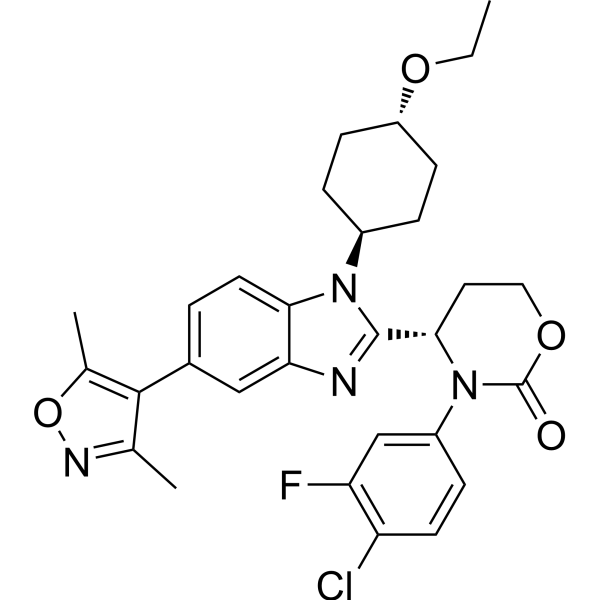 0 ImagesCat. No.: HY-160260CAS No.: 2638507-71-6EP300/CBP-IN-1 (compound 172) is a potent EP300/CBP inhibitor with IC50s of 2.3 nM and 2.1 nM for CBP BRD and EP300 BRD, respectively. EP300/CBP-IN-1 has the inhibitory effect on the proliferation of prostate cancer CWR22RV1 cells.
-
SNIPER(BRD)-1 (Standard)
 0 ImagesCat. No.: HY-111875RCAS No.: 2095244-54-3SNIPER(BRD)-1 (Standard) is the analytical standard of SNIPER(BRD)-1 (HY-111875). This product is intended for research and analytical applications. SNIPER(BRD)-1 is a SNIPER degrader of BRD4, cIAP1 and XIAP. SNIPER(BRD)-1 has IC50 values of 6.8 nM, 17 nM and 49 nM for cIAP1, cIAP2 and XIAP, respectively. SNIPER(BRD)-1 can be used for cancer research. (Blue: LCL161 (HY-15518); Black: linker (HY-W008005); Pink: (+)-JQ-1 (HY-13030))
-
GSK6853 (Standard)
 0 ImagesCat. No.: HY-100220RCAS No.: 1910124-24-1GSK6853 (Standard) is the analytical standard of GSK6853 (HY-100220). This product is intended for research and analytical applications. GSK6853, a chemical probe, is a potent and selective inhibitor of the BRPF1 bromodomain. GSK6853 shows excellent BRPF1 potency (pKd = 9.5) and greater than 1600-fold selectivity over all other bromodomains.
-
CBP/p300-IN-24
 0 ImagesCat. No.: HY-W173361CAS No.: 56369-21-2CBP/p300-IN-24 is a selective CBP bromodomain inhibitor with an IC50 of 32 μM, showing selectivity over BRD4 BD-1 bromodomain. CBP/p300-IN-24 binds to the acetyl lysine binding pocket, forms hydrogen bonds with Asn1168 and a solvent-mediated hydrogen bond with Tyr1125, and forms hydrophobic interactions with Leu1120, Ile1122, and Val1174.
-
TPOP146 (Standard)
 0 ImagesCat. No.: HY-100697RCAS No.: 2018300-62-2
-
TP-472 (Standard)
 0 ImagesCat. No.: HY-100517RCAS No.: 2079895-62-6TP-472 (Standard) is the analytical standard of TP-472 (HY-100517). This product is intended for research and analytical applications. TP-472, a chemical probe, is a selective BRD9/7 inhibitor, with Kds of 33 nM and 340 nM for BRD9 and BRD7, respectively. TP-472 exhibits >30-fold selectivity for BRD9 over other bromodomain family members except BRD7. TP-472 induces apoptosis of melanoma cells.
-
BAY-299 (Standard)
 0 ImagesCat. No.: HY-107424RCAS No.: 2080306-23-4
-
Ertabresib (Standard)
 0 ImagesCat. No.: HY-111485RCAS No.: 1820889-23-3Synonyms: INCB-057643 (Standard)Ertabresib (Standard) (INCB-057643 (Standard)) is the analytical standard of Ertabresib (HY-111485). This product is intended for research and analytical applications. Ertabresib (INCB-057643) is an orally active BET protein inhibitor. Ertabresib blocks gene transcription by targeting the BET protein family, induces cell cycle arrest and apoptosis by downregulating proto-oncogenes such as c-MYC, and additionally reduces the expression of FOXP3 and PD-L1 to improve the immune microenvironment. It also exerts synergistic effects and overcomes drug resistance when combined with chemotherapy and XPO1 inhibitors. Ertabresib can be used in research related to high-grade B-cell lymphoma with MYC and BCL2 rearrangements, pancreatic cancer, pancreatitis, and metastatic castration-resistant prostate cancer.
-
Y06137 (Standard)
 0 ImagesCat. No.: HY-111503RCAS No.: 2226534-49-0Y06137 (Standard) is the analytical standard of Y06137 (HY-111503). This product is intended for research and analytical applications. Y06137 is a potent and selective BET inhibitor for treatment of castration-resistant prostate cancer (CRPC). Y06137 binds to the BRD4(1) bromodomain with a Kd of 81 nM.
-
BI-9564 (Standard)
 0 ImagesCat. No.: HY-100352RCAS No.: 1883429-22-8BI-9564 (Standard) is the analytical standard of BI-9564 (HY-100352). This product is intended for research and analytical applications. BI-9564, a chemical probe, is a potent, selective and cell-permeable BRD9/BRD7 bromodomains inhibitor, with IC50s of 75 nM and 3.4 μM and Kds of 14 nM and 239 nM, respectively. BI-9564 has an IC50 of > 100 μM for BET family.




